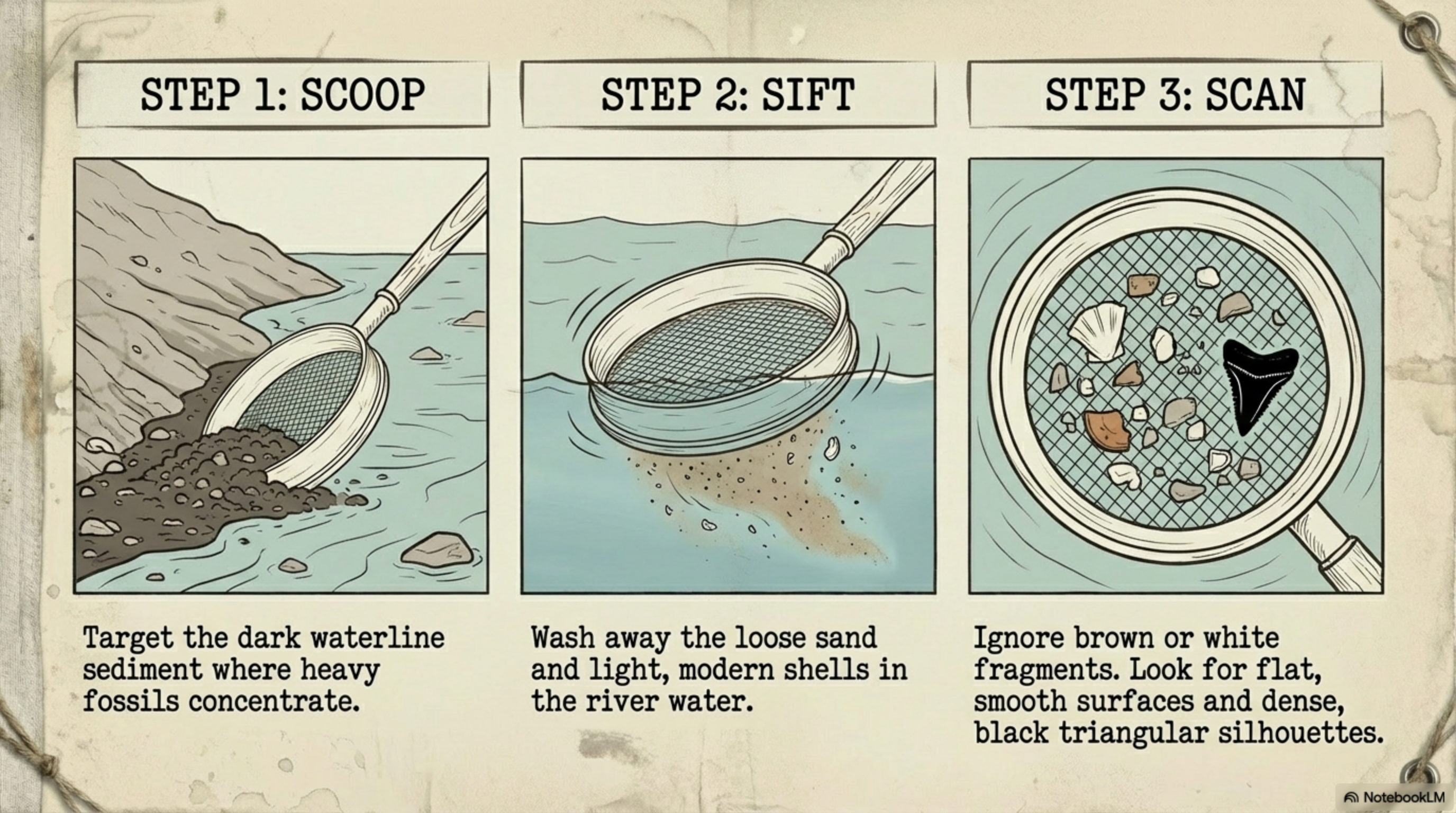
Most first-time visitors to Shark Tooth Island either find nothing or find so many broken shell fragments they stop trusting their eyes. Both are fixable.
Finding fossil shark teeth is more of a filtering skill than a search skill. The teeth are there. The question is whether you can sort them out from the shells, the pebbles, and the noise.
Not all of the island shoreline is equal. The teeth concentrate where moving water has sorted the sediment by density. A few places reliably out-perform others.
The waterline at low tide. This is the single most productive strip. Tidal action concentrates heavy material here, then exposes it as water drops. Work back and forth along the edge.
Dark shell beds. Thick, darker material often signals reworked fossil-bearing sediment. If the beach looks monochrome tan, keep moving. If it looks banded and black-heavy, stop and sift.
Pockets and low spots. Anywhere water pools and drains, heavier material gets left behind. Check the bottom of small gullies, depressions behind shell piles, and backwater edges.
The other islands in the cluster. Shark Tooth Island gets the attention, but Keg Island and nearby spoil features are in the same geological story. Worth a paddle.
Fossil shark teeth have a specific visual signature. Once you've picked up a handful of real ones, you'll spot them faster than you can explain why.
Color. Black, gray-black, dark brown, sometimes tan. But the color goes all the way through. Shell fragments are usually lighter on the broken edges.
Shape. Triangular silhouette, with a crown and a distinct root. Some species (like tiger sharks) have a hooked or notched profile. Symmetric or near-symmetric in most cases.
Surface. The crown (blade) is smooth and flat — that's mineralized enamel. The root is more porous and matte. Shell fragments almost always show layered growth lines on at least one face.
Weight. Fossil teeth are dense. Heavy for their size. If it feels like it should weigh more than it does, it probably does.
Serrations. Some species (great white, megalodon, tiger) have serrated edges. Others (makos) do not. Serrations on a dark triangle is a strong signal.
If you're still on the fence, see Fossil vs Shell for the side-by-side.
Slowing down. The first instinct is to cover ground. The better instinct is to commit to a two-meter patch and search it until you're sure it's empty, then move on. Teeth hide among identical-colored stones. Give your eyes time to calibrate.
Working with the tide, not against it. Rising water will bury what you haven't found yet. Start early in the low-tide window, not at the bottom of it.
The small stuff. Everyone wants a megalodon. Most of what's surfacing is under 40 mm. Sub-30 mm teeth from bull shark, snaggletooth, and small sand tigers are common and easy to miss. Small finds build the eye for larger ones.
Picking things up. Hold anything that looks plausible. Feel the weight. Rotate it. Look at the root. Most identification happens in your hand, not from three feet above.