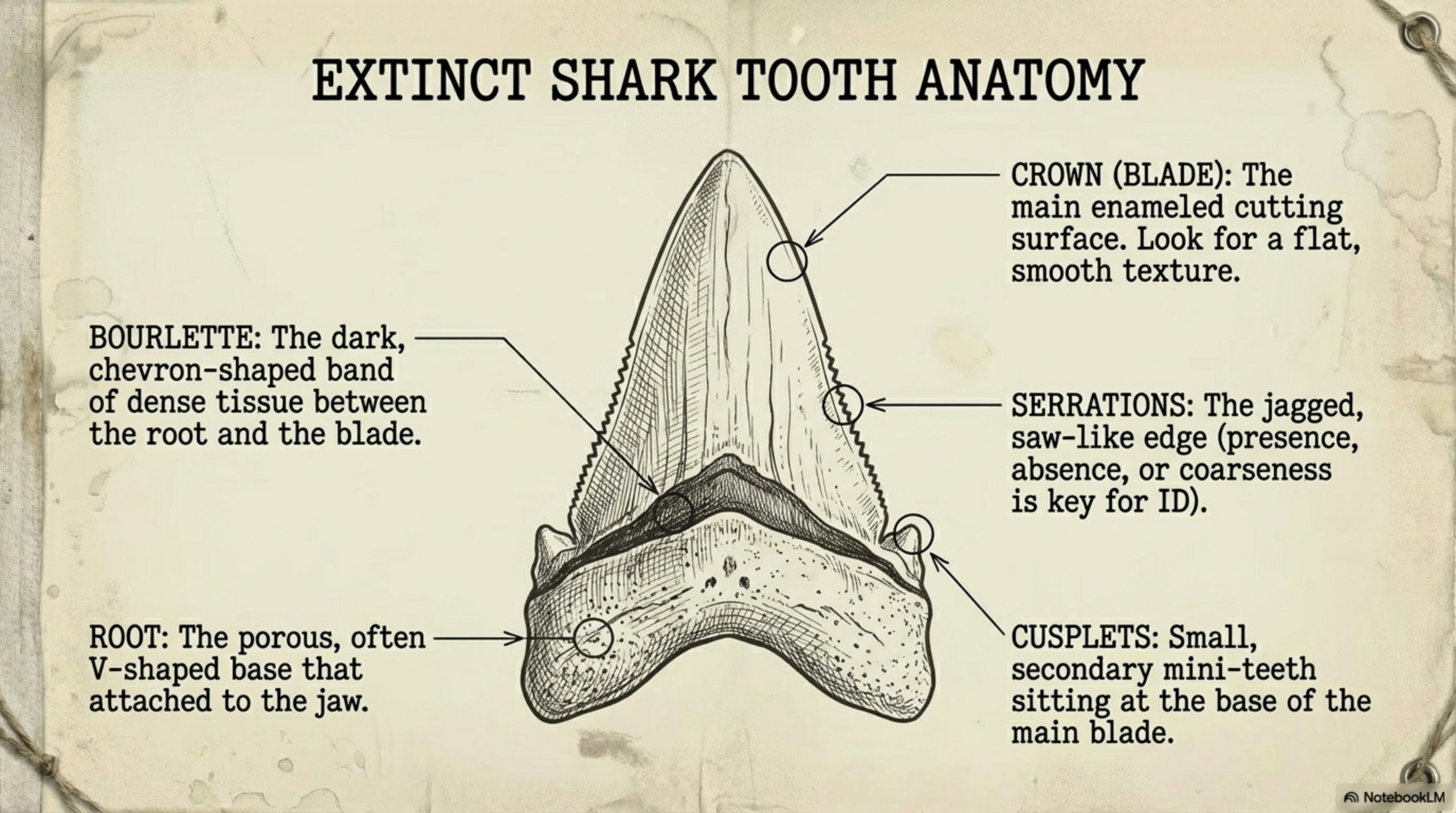
Most shark teeth share the same basic architecture. Once you can name the parts, identification gets easier — because what separates one species from another usually comes down to the presence, absence, or shape of a specific feature.
A serrated edge or not. A chevron-shaped band at the base or not. Side cusplets or not. Five or six details, and you can usually narrow a find to a handful of possibilities.
A simple decision tree works surprisingly well once you know the parts:
- Check the edge. Serrated or smooth? Fine or coarse? Full length or partial?
- Check for a bourlette. If yes — narrow to megalodon or close relatives. If no — broader field.
- Check the crown shape. Triangular, curved, hooked, or broad?
- Check for cusplets. Present? Pointed or rounded? Absent?
- Check the root. Forked or flat? Complete or worn?
Five questions. Most finds narrow down in under a minute. For the species most common at Shark Tooth Island, see the species catalog.
Most of what surfaces at Shark Tooth Island is partial. Roots break off. Tips wear away. The blade can fracture. This is normal, and a broken tooth is still worth keeping — the remaining anatomy is often enough for ID.
Priority of clues when something's missing: serrations first (they identify fast), bourlette second (if the base is intact), crown shape third. Root alone can be tough to ID, but pair it with other visible detail and you can usually get there.
If the tooth is worn smooth and you can't see any of these features clearly, photograph it next to a ruler and post it somewhere with ID expertise. Worn teeth aren't worthless — they're just harder.